
Property Consultant in Delhi: Delhi’s 3 Upcoming Transit Hubs Every Property Buyer Should Know
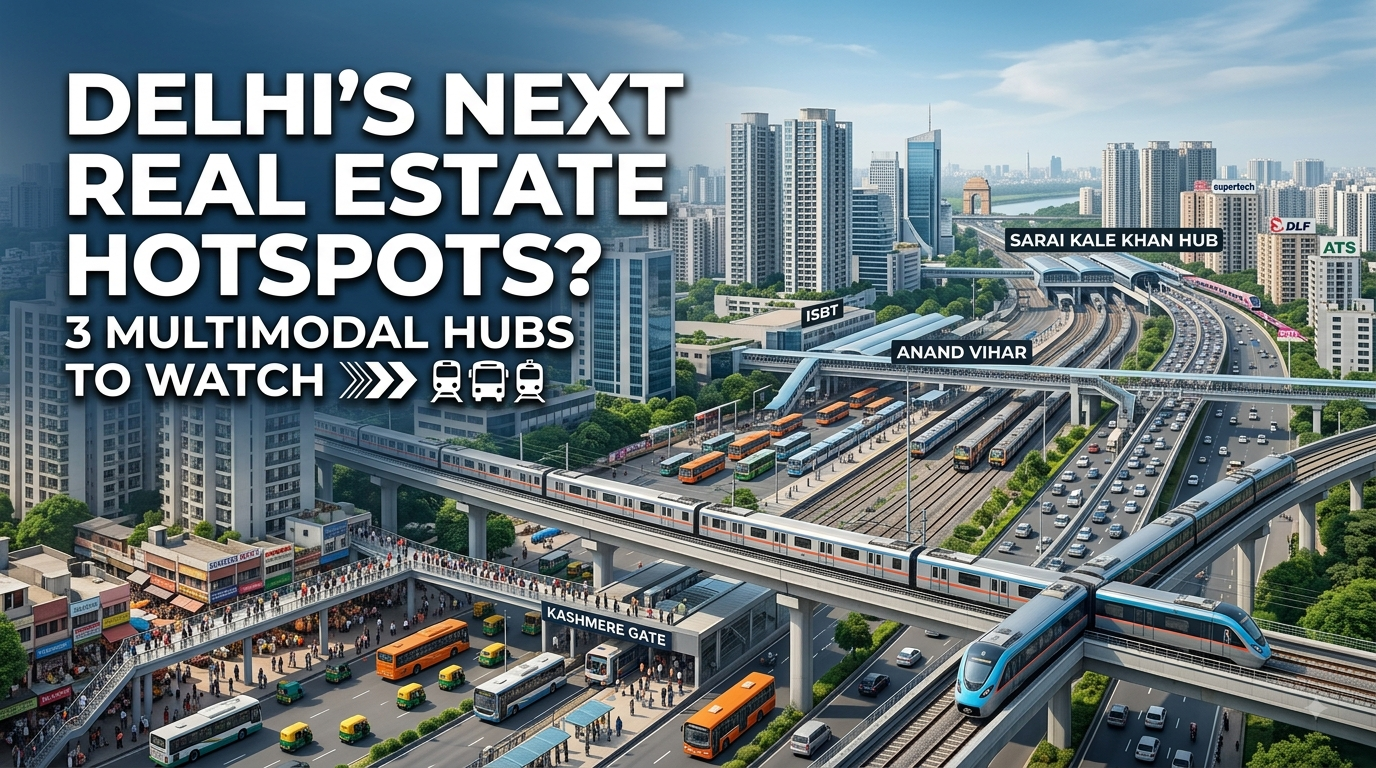
Delhi’s planned multimodal transit hubs at Anand Vihar-Karkardooma, Kashmere Gate and Nizamuddin-Sarai Kale Khan are designed to bring metro, railway, bus, RRTS, para-transit and non-motorised transport closer together. Better connectivity can increase the attractiveness of surrounding residential and commercial locations, making these corridors important areas to monitor for future property investment in Delhi and Delhi NCR. The three hubs are identified in Delhi’s master-planning framework.
Key Takeaways for Property Buyers and Investors (Property Consultant in Delhi)
Anand Vihar-Karkardooma, Kashmere Gate and Nizamuddin-Sarai Kale Khan are identified as important multimodal transit locations.
The objective is to integrate multiple modes of public transport and improve passenger interchange.
Transit-oriented development can encourage mixed-use and higher-density development around major transport nodes.
Anand Vihar is particularly significant because of its combination of rail, metro, bus and RRTS connectivity.
Improved last-mile connectivity can make surrounding residential and commercial markets more attractive.
Infrastructure announcements should not automatically be treated as guaranteed property appreciation.
Buyers should evaluate RERA status, developer credentials, location, access, pricing, rental demand and actual implementation timelines before investing.
For investors, the biggest opportunity may come from identifying the right micro-market before infrastructure benefits are fully reflected in prices.
Why are Anand Vihar, Kashmere Gate and Sarai Kale Khan important for Delhi real estate?
Delhi is gradually moving towards a more integrated public transportation network. The idea is simple: instead of treating metro stations, railway stations, bus terminals and regional transport as separate systems, multiple modes can be planned as part of a connected mobility ecosystem.
The Delhi master-planning framework identifies three important multimodal transit hubs:
Anand Vihar-Karkardooma
Kashmere Gate
Nizamuddin-Sarai Kale Khan
The official Master Plan for Delhi identifies these locations for development as Multi-Modal Transit Hubs, while also allowing additional locations to be identified in the future.
For property buyers, this is important because transportation infrastructure is one of the factors that can influence how a location develops over time.
For a Property Consultant in Delhi, therefore, these infrastructure developments are not just transportation stories. They are important signals to watch when analysing future residential, commercial and investment markets.
What is a Multimodal Transit Hub?
A multimodal transit hub is a location where different transportation systems are integrated so that passengers can move between them more easily.
Depending on the location, this can include:
Delhi Metro
Indian Railways
RRTS
Inter-state bus services
Local buses
Auto-rickshaws and other para-transit
Walking infrastructure
Cycling facilities
Pick-up and drop-off areas
Public parking
Retail and public spaces
The Delhi master plan framework also discusses multimodal integration at transit stations and major bus terminals, including pedestrian and cycling facilities.
The real estate significance is straightforward: when a location becomes easier to reach from multiple parts of a city and region, its accessibility can become a major part of its long-term attractiveness.
How could Anand Vihar-Karkardooma become a major real estate growth corridor?
Among the three locations, Anand Vihar-Karkardooma has a particularly interesting connectivity story.
The area already has important transport infrastructure, while the wider planning framework connects Anand Vihar and Karkardooma with transit-oriented development.
NCRTC has also undertaken consultancy work related to the Anand Vihar Multimodal Transit Hub, the Karkardooma Pink and Blue Line metro stations and the Nizamuddin-Sarai Kale Khan Multimodal Transit Hub.
In 2026, proposals reported for Anand Vihar included measures such as an underpass, pedestrian connectivity improvements and a bridge with a travellator to improve movement around the railway station, ISBT and RRTS station.
For real estate, this creates an important investment question:
Could better connectivity increase demand for properties around Anand Vihar and Karkardooma?
Potentially, yes.
However, investors should distinguish between:
planned infrastructure → construction → operational infrastructure → actual demand growth
A project announcement alone does not guarantee price appreciation.
What does the Kashmere Gate Multimodal Hub mean for property buyers?
Kashmere Gate is already one of Delhi’s most established transportation locations.
Its strategic importance comes from the combination of metro connectivity, the ISBT, road networks and access to major parts of central and north Delhi.
The Delhi master plan identifies Kashmere Gate as one of the three locations to be developed as a Multimodal Transit Hub.
The location also demonstrates why transit infrastructure and commercial real estate can be closely connected.
High passenger movement creates demand for:
Retail spaces
Convenience stores
Offices
Short-stay accommodation
Rental housing
Service businesses
Earlier redevelopment discussions around Kashmere Gate ISBT also highlighted the commercial potential of retail and food spaces because of the location’s high passenger footfall and connectivity.
This makes Kashmere Gate an important micro-market for anyone researching commercial property in Delhi.
Why could Sarai Kale Khan-Nizamuddin become an important investment zone?
Sarai Kale Khan and Nizamuddin sit at an important intersection of Delhi’s transport network.
The area connects road, railway and regional transportation infrastructure and has been identified as a multimodal transit location.
The Delhi master plan specifically identifies Nizamuddin-Sarai Kale Khan as one of the three proposed Multi-Modal Transit Hubs.
NCRTC’s work on the influence-zone planning for the Nizamuddin-Sarai Kale Khan hub further demonstrates the importance of this corridor within the broader Delhi-Meerut RRTS ecosystem.
For property investors, the opportunity is not limited to buying a home.
The potential real estate segments can include:
Residential apartments
Builder floors
Rental housing
Serviced accommodation
Office spaces
Retail
Commercial property
Hospitality-related assets
The right opportunity, however, depends on the exact location, title, approvals, connectivity and demand profile.
How can Transit-Oriented Development affect Delhi property investment?
Transit-Oriented Development, or TOD, focuses on creating compact, connected and mixed-use development around public transportation.
The idea is to make everyday destinations more accessible through walking, cycling and public transport instead of depending entirely on private vehicles.
Delhi’s TOD framework has identified multimodal hubs as important development nodes. DDA’s identified TOD nodes include Kashmere Gate, Nizamuddin-Sarai Kale Khan, Anand Vihar and Karkardooma, among other locations.
This can create a different type of real estate ecosystem.
Instead of:
Residential area → long commute → separate commercial district
the model can move towards:
Homes + offices + retail + public transport + amenities within a connected urban zone
For investors, this can potentially support stronger rental demand and commercial activity, provided the planned development is successfully implemented.
What should property buyers look for around future infrastructure corridors?
Infrastructure creates opportunity, but smart investors need to look beyond headlines.
Before buying property in Delhi or Delhi NCR, evaluate these factors:
- Distance from the actual transit node
A property being in the same broad locality does not mean it will receive the same connectivity benefit.
Check the actual road access and walking distance.
- Existing connectivity
Do not invest only because a future project has been announced.
Look at what connectivity exists today.
- Future infrastructure
Check whether the proposed infrastructure is officially planned, under construction, tendered or merely conceptual.
- RERA and approvals
For new residential or commercial projects, verify the applicable RERA registration and approvals.
- Rental demand
A good investment location should have a genuine tenant or occupier base.
- Supply pipeline
If too many properties are being developed simultaneously, future supply can affect rental and resale performance.
- Developer track record
Research the developer’s previous projects, delivery history and legal record.
Ask a simple question:
Who will buy this property from me five or ten years from now?
That question can be more important than simply asking today’s price.
Is this the right time to invest in Delhi real estate?
There is no single answer for every buyer.
The right investment depends on the purpose.
Buyer Type : What to Evaluate?
End User Connectivity, schools, hospitals, daily convenience
Long-Term Investor Infrastructure, employment growth and future demand
Rental Investor Tenant demand, rental yield and connectivity
Commercial Investor Footfall, visibility, catchment and business activity
First-Time Buyer Budget, EMI affordability, RERA and resale potential
HNI/NRI Investor Location quality, developer credibility and long-term capital preservation
This is where a professional Property Consultant in Delhi can add value.
Instead of simply showing available properties, the consultant should help compare location, infrastructure, demand, pricing, legal status and future potential.
How can a Property Consultant in Delhi help investors identify the right opportunity?
The biggest mistake investors make is buying a property only because they heard that an infrastructure project is coming.
A professional real estate consultation should answer:
Where is the infrastructure coming?
When is it expected to become operational?
How accessible is the property today?
What type of demand exists in the area?
What competing supply is coming?
Is the property legally and financially suitable?
What is the likely buyer or tenant profile?
This approach turns a simple property search into a proper investment analysis.
BOP.in works across residential, commercial and land opportunities in Delhi NCR and provides property consultation for buyers and investors looking to evaluate opportunities based on location, project and investment requirements.
What does Delhi’s 2047 vision mean for future property investment?
Delhi’s long-term planning is increasingly focused on connectivity, integrated mobility, public transport and better urban infrastructure.
However, buyers should understand an important distinction.
The officially available DDA master-plan document identifies the three multimodal hubs, while reporting in 2026 indicated that the horizon year of Delhi’s Master Plan 2041 was being considered for extension to 2047. The 2041 plan itself had been approved by DDA in 2023 but had not yet been notified as of the June 2026 report.
Therefore, investors should treat Delhi 2047 as a long-term planning and vision context rather than assuming that every proposed infrastructure element is already a sanctioned, operational project.
This distinction is important for making responsible real estate decisions.
What are the biggest real estate opportunities created by better connectivity?
Better connectivity can influence several property segments.
Residential Property
Locations with multiple transport options can become attractive for professionals and families who want shorter commuting times.
Rental Property
A larger catchment of workers, students and professionals can support rental demand where employment and amenities are also present.
Commercial Property
Retail, food, offices and service businesses can benefit from high accessibility and pedestrian movement.
Investment Property
Long-term investors may track emerging micro-markets before infrastructure improvements are fully reflected in market expectations.
But infrastructure should always be one part of the investment decision, not the entire decision.
What should Delhi-NCR investors learn from the Anand Vihar, Kashmere Gate and Sarai Kale Khan story?
The larger lesson is bigger than these three locations.
Infrastructure creates connectivity. Connectivity can create accessibility. Accessibility can influence demand. Demand can influence real estate markets.
But the complete investment cycle takes time.
That is why investors should identify emerging corridors early, conduct proper due diligence and compare opportunities rather than blindly following an infrastructure headline.
For Delhi NCR buyers, the same approach can be applied to other major infrastructure corridors involving metro expansion, RRTS, expressways, airports and regional connectivity.
Why choose BOP.in for your Delhi NCR property search?
Real estate investment is not simply about finding a property.
It is about finding the right:
Location + Project + Developer + Price + Connectivity + Demand + Exit Strategy
BOP.in brings residential, commercial and land opportunities together across Delhi NCR and provides buyers with access to property options and professional real estate guidance. The company currently lists a dedicated Delhi office and operates across multiple NCR markets.
If you are evaluating property investment in Delhi, commercial property in Delhi, or emerging Delhi NCR real estate opportunities, the BOP.in team can help you compare suitable options based on your budget and investment objective.
Looking for the next real estate opportunity?
Don’t invest only because a location is trending.
Understand the infrastructure.
Study the micro-market.
Compare the projects.
Verify the approvals.
Then make your decision.
Connect with BOP.in to explore verified residential and commercial property opportunities and identify projects that match your investment requirements.
Your next property decision should be based on information, not speculation.
Frequently Asked Questions About Delhi Multimodal Hubs and Property Investment
What are the three multimodal transit hubs planned in Delhi?
The three identified locations are Anand Vihar-Karkardooma, Kashmere Gate and Nizamuddin-Sarai Kale Khan. They are intended to integrate multiple modes of transportation and improve passenger interchange.
How will Anand Vihar Multimodal Hub affect property investment?
Improved integration between rail, metro, bus and RRTS can make Anand Vihar-Karkardooma more accessible. Investors should monitor connectivity, commercial activity, rental demand and actual infrastructure implementation before making a property investment decision.
Is Anand Vihar a good location for property investment?
Anand Vihar has strong existing transportation infrastructure and is also part of the multimodal and TOD planning framework. Whether a specific property is a good investment depends on its exact location, price, legal status, demand and future connectivity.
What is the Kashmere Gate Multimodal Transit Hub?
Kashmere Gate is identified as a Multimodal Transit Hub where different transport systems can be integrated to make passenger movement easier. The area is already an important metro and bus transportation node.
Is Kashmere Gate good for commercial property investment?
Kashmere Gate’s transportation connectivity and passenger movement can make it an important commercial market. Investors should evaluate visibility, footfall, permitted use, rental demand, property title and pricing before purchasing commercial property.
Why is Sarai Kale Khan important for Delhi real estate?
Sarai Kale Khan-Nizamuddin is strategically important because of its transport connections and its identification as a multimodal transit hub. Its relationship with regional transport infrastructure makes it an important corridor to monitor for future real estate development.
What is TOD in Delhi real estate?
TOD stands for Transit-Oriented Development. It promotes compact, mixed-use and accessible development around public transportation. Delhi’s planning framework identifies several transit nodes for TOD development.
Can infrastructure increase property prices in Delhi?
Infrastructure can influence property demand and market attractiveness, but price appreciation is not guaranteed. Employment, supply, affordability, developer quality, legal status and actual infrastructure delivery also matter.
Should I buy property near a proposed metro or RRTS project?
Not solely because of the proposed project. Check the official status, expected timeline, exact distance, current connectivity, property price, RERA registration and future supply before investing.
How can a Property Consultant in Delhi help me?
A professional property consultant can help compare residential and commercial projects, understand local market conditions, evaluate connectivity and identify properties according to budget and investment objectives.
Where can I find property investment opportunities in Delhi NCR?
Buyers can explore residential, commercial and land opportunities through established real estate consultants and verify each project independently for RERA registration, approvals, developer credentials and transaction terms.
Is Delhi 2047 Master Plan already final?
The terminology needs care. The available DDA master-plan framework identifies the three multimodal hubs, while reporting in June 2026 indicated that the government was considering changing the horizon year of Delhi’s Master Plan 2041 to 2047. Investors should therefore distinguish between an approved/official planning document, a proposed modification and an operational infrastructure project.
What is the biggest opportunity for Delhi NCR property investors?
The biggest opportunity is not necessarily one particular location. It is identifying areas where infrastructure, employment, connectivity, residential demand and commercial activity are developing together, while entering at a price that makes financial sense.
Final Word: Delhi’s Future Connectivity Could Create New Real Estate Opportunities (Property Consultant in Delhi)
Anand Vihar-Karkardooma, Kashmere Gate and Nizamuddin-Sarai Kale Khan demonstrate how transportation planning and real estate development can influence each other.
The proposed multimodal approach aims to bring different transport systems closer together, improve last-mile connectivity and create more integrated urban spaces.
For property buyers, this means one thing:
Connectivity deserves to be part of every serious Delhi real estate investment analysis.
But smart investing requires more than following a headline.
Track the infrastructure.
Study the micro-market.
Check the project.
Understand the demand.
And take professional advice before committing capital.
If you are looking for a Property Consultant in Delhi to help identify residential, commercial, or investment opportunities across Delhi-NCR, connect with BOP.in and explore the right property options for your requirements.
BOP.in — Simple. Smart. Real Estate (Property Consultant in Delhi)



All Categories
- Appartments
- Articles
- Bop property consultants
- Fitness Zone
- hotel
- House
- Jewar Airport
- Land
- Land in noida
- Luxury
- Mathura
- Metro Connectivity
- Noida International Airport
- Property Consultant
- property consultant in delhi
- property consultants noida
- property dealer delhi
- Property in Mathura and Vrindavan
- Property on yamuna expressway
- RERA
- Restaurant
- Top builders of NCR
- Uncategorized
- Vrindavan